 Corporate crime has been happening as long as there have been corporations. But if you wanted to choose an event that marked the emergence of what we think of as modern big business misconduct it would be the admission by Enron in November 2001 that it had overstated profits by $600 million. Within months, the high-flying energy trader collapsed amid growing evidence that the company was one big scam. Enron’s lenders, investors, auditors and others were all pulled into the morass.
Enron turned out to be just one of a rash of accounting scandals that rocked the corporate world and severely damaged the legitimacy of American capitalism. The Bush Administration felt compelled to create a President’s Corporate Fraud Task Force headed by none other than James Comey.
I bring up this history because the Corporate Research Project is about to release a major expansion of Violation Tracker that will extend coverage to this period. We are adding ten more years of data, bringing the starting point back to January 2000. The expansion will nearly double the size of the database to 300,000 entries with more than $394 billion in fines and settlements.
More than 95 percent of that penalty amount comes from our universe of large parent companies, which is being increased to about 2,800. These include ones that are publicly traded and privately held, for-profit and non-profit, domestic as well as foreign-based.
Now the universe also includes a bunch of companies like Enron that are defunct but which are kept on the list for historical purposes. Here are some of those zombies. Note that Violation Tracker does not yet include entries relating to private litigation.
The largest penalty total comes from Adelphia Communications, a cable television provider that was riddled with corruption. In 2004 the Justice Department arranged for $715 million of what remained of the company to be handed over to a fund set up to compensate victims of Adelphia.
In 2002 WorldCom, another telecommunications company, filed what was then the largest bankruptcy ever in the wake of a massive accounting scandal. In 2002 the Securities and Exchange Commission reached a $500 million settlement with the company after originally seeking $1.5 billion in penalties. Since WorldCom was taken over by Verizon rather than being dismantled, its entries in Violation Tracker are listed under Verizon.
Enron shows up in nine entries with a penalty total of $446 million, the largest of which was a 2006 agreement with the Federal Energy Regulatory Commission giving the agency a $400 million claim in the company’s bankruptcy proceeding stemming from Enron’s misconduct during the 2000-2001 Western energy crisis.
We also list Arthur Andersen, which had served as Enron’s auditor and was convicted of obstruction of justice for shredding documents relating to that client. The conviction was overturned by the U.S. Supreme Court (and thus is not listed in Violation Tracker) but the firm never recovered from the scandal. We list a $7 million penalty imposed on Andersen by the SEC in 2002 in connection with its audits of Waste Management in the 1990s.
The corporate scandals of the early 2000s shook up the country and in some ways prompted even more aggressive remedial actions than are seen with more recent cases. There were many more criminal prosecutions of individual executives than occurred with the cases stemming from the financial meltdown, though the dollar amounts of penalties have grown larger.
One thing that has not changed is the persistence of wrongdoing by so many large corporations.
Note: The Violation Tracker expansion will officially launch on September 19.
 Donald Trump likes to give the impression that he has made great strides in dismantling regulation. While there is no doubt that his administration and Republican allies in Congress are targeting many important safeguards for consumers and workers, the good news is that those protections in many respects are still alive and well.
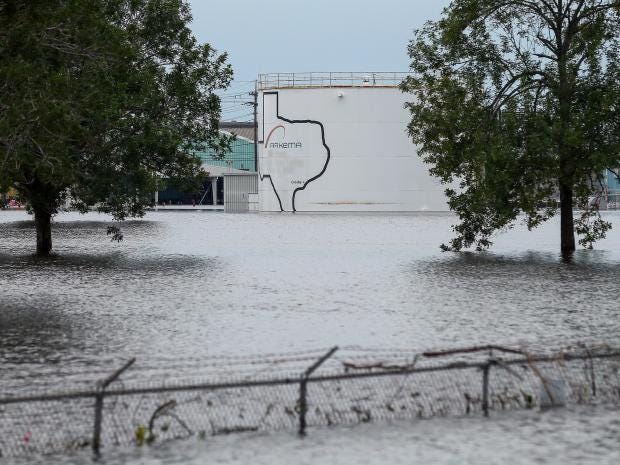 Much of the Gulf region remains flooded, people are still being rescued, and the full magnitude of the damage is not yet known. But soon the center of attention will be the rebuilding effort and how to pay for it.
 Donald Trump has built an image as a champion of workers by fomenting fear of immigrants. Get rid of the foreign-born, he vows, and native workers will prosper.
 Jobs versus the environment: The notion that the interests of workers were inherently anti-ecological was widely held in the 1980s. Much of the world now accepts that employment and environmental protection can go hand in hand, but the Trump Administration is trying hard to turn back the clock. Dismantling safeguards is presented as the key to job creation.
 It’s common for governors to stage publicity events to announce major job-creating investments in their state. This allows them to take implicit credit for a project that was probably helped along with tax breaks and other financial giveaways.
 When Betsy DeVos was nominated to head the Department of Education, the main concern was what harm a “choice” crusader would bring to K-12 public schools. Recently we’ve seen that she can also cause damage with regard to post-secondary education.
 Many voices are speaking out about the Republican effort to undo the Affordable Care Act, but one party diligently refrains from public comment: the insurance industry. While the industry is undoubtedly exerting its influence in the closed-door negotiations to restructure the wildly unpopular GOP bill, it is not airing those views more widely.
 Americans may have initially felt a bit smug upon learning that the combustible material responsible for the Grenfell Tower disaster in London is largely banned in the United States. Perhaps our regulatory system is not as deficient as we thought.