Another Assault on Democracy

Defenders of big business have long claimed that large publicly traded companies are democratic institutions, since shareholders are able to vote on issues of corporate policy. Activist groups, in turn, have used that avenue to press for changes in harmful practices.

This system, which has significant limitations, is set to become a lot less effective as the result of a rule change being proposed by the Securities and Exchange Commission. The SEC wants to eliminate Rule 14a-8, which would, in effect, free corporations of the obligation to include qualifying shareholder proposals in the proxy statements that are sent out in advance of annual meetings.

Paul Atkins, who was chosen by Trump to run the SEC, put out a statement disingenuously claiming the move is designed to ensure that “the Commission does not improperly intrude into state corporate law,” while failing to mention that this supposed intrusion has been in place since the 1940s.

By removing the SEC from consideration of shareholder resolutions, Atkins would leave it up to the states to oversee the process. Atkins knows full well that most large corporations are chartered in states such as Delaware that will adopt policies that would make it less likely that proposals will end up in proxy statements. Given the difficulties in publicizing proposals on their own, shareholder activists could very well give up on the effort.

Groups such as the Interfaith Center on Corporate Responsibility (ICCR) have been using the proposal process for decades. Often this does not involve an actual vote by shareholders, which in any event is not binding. Since managers would prefer that the vote never take place, activists can win concessions by agreeing to withdraw a resolution. The SEC’s proposal would likely eliminate that leverage.

The ICCR put out a statement questioning the legality of the proposed rule change and vowing to fight it. The big question is whether public pension funds and other institutional investors will take a strong stance on the issue. One encouraging sign: New York State Comptroller Thomas P. DiNapoli, trustee of the New York State Common Retirement Fund, issued a statement saying: “With this attempt to rescind Rule 14a-8, the SEC has chosen to allow corporate management to shield themselves from accountability rather than protect the investors it was created to serve. I will continue to fight to defend the NYS pension fund’s rights as a shareholder against these reckless attacks.”

Corporate America, on the other hand, is welcoming the move. The U.S. Chamber of Commerce praised the SEC, adding: “For too long, special interests have exploited Rule 14a-8 to advance their own agendas at the expense of public companies and their shareholders.” Leave it to the Chamber, the voice of some of the most powerful entities in the country, to pretend that it, and not the likes of ICCR, represents the public interest.

The elimination of Rule 14a-8 would not mean the complete disappearance of shareholder activism. Some states might adopt policies on resolutions that are not draconian, and there are tactics other than resolutions that activists can use to pressure management.

Yet the withering of the resolution process would represent another troubling step in the consolidation of corporate power.
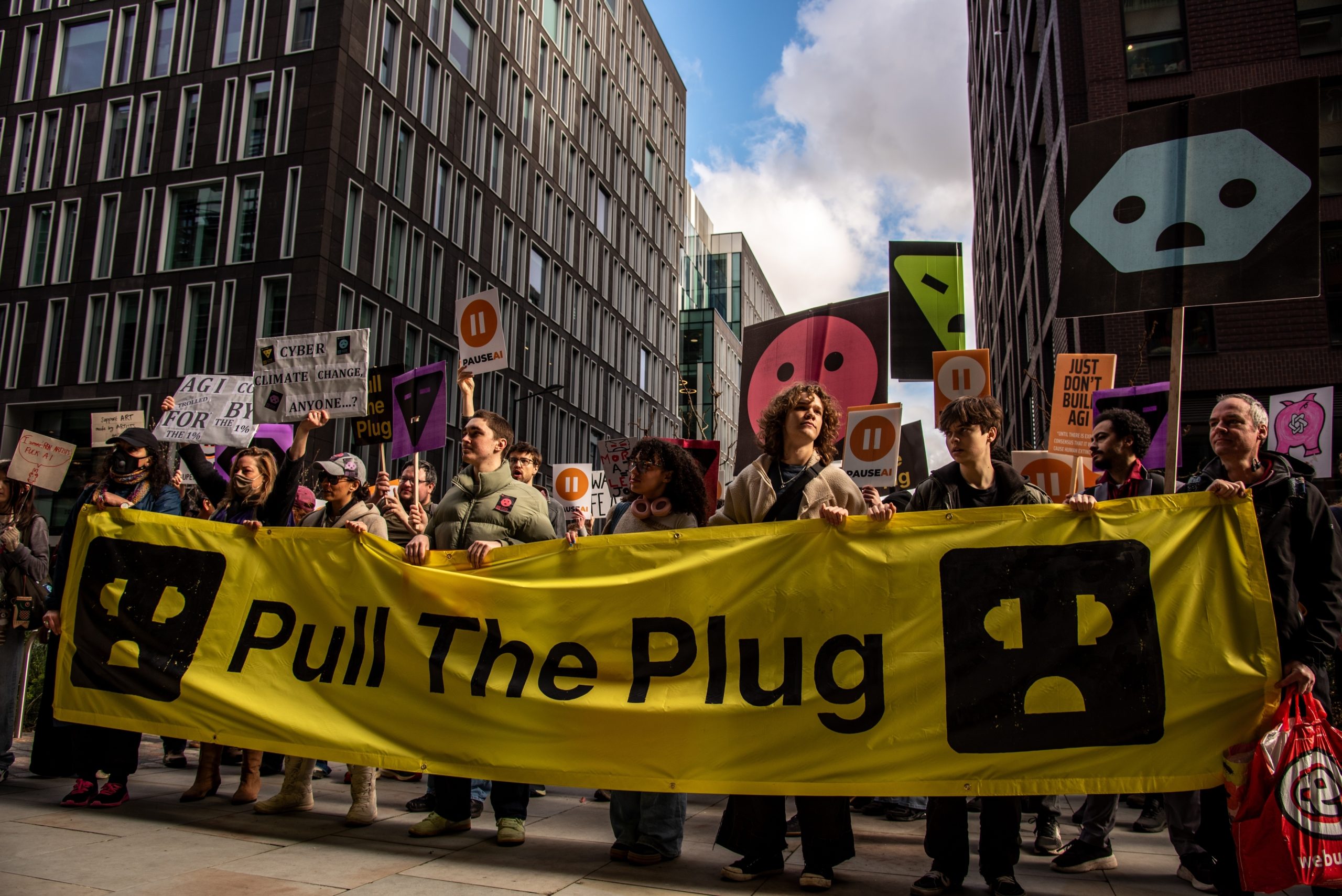
What Are the AI Giants Really Up to?

There is something quite bizarre about the current debate on artificial intelligence. Never before have the heads of major corporations come out with warnings that their own products could threaten the future of the human race.

Such statements cannot be taken at face value. If Dario Amodei, Sam Altman, and Elon Musk believe those catastrophic possibilities to be literally true, they would be talking about dismantling AI, not simply slowing down its progression.

I’m not suggesting that the risks of AI are entirely fabricated, but the industry leaders seem to be using worst-case scenarios to try to throw us into a panic. The question is why.

One possibility is they are seeking to promote the idea that the dangers are so great that only they are qualified to handle them. This would be a bold new form of regulatory capture. The implied message is that only the geniuses who built AI are in a position to try to control it.

The AI barons may thus be setting the stage for a system of industry self-regulation that will not seriously inhibit their actions but give the impression they are addressing the risks. This would be similar to the mostly toothless measures adopted by social media companies in response to concerns about the harms to young people.

It is true that the AI leaders have made reference to government involvement, but it is likely they are doing so on the assumption that any such intervention will be less than robust or will not materialize at all. Donald Trump reinforced that supposition by immediately coming out in opposition to any new controls on AI, saying all that is needed is a “strong and smart (high IQ!) president.”

Another possibility is that the big AI companies are serious about wanting a slowdown, but they would seek to shape it so that it solidifies their dominant position by making it more difficult for competitors to emerge. The adoption of new guardrails on the technology would make it much more expensive to develop new AI products and thus price out upstart companies.

The AI industry may also be promoting cataclysmic thinking as a way of inoculating themselves against future legal liability. They could be assuming that by issuing their warnings now, they will be blamed less later when serious, but not quite extinction-level, consequences begin to materialize. We warned you, they may anticipate saying, and you failed to take appropriate action.

By offering up the worst possible scenarios, the industry may be seeking to numb people to the risks. Looking at what has happened with the climate crisis, they may be thinking that all the talk of catastrophe and human extinction will cause many to adopt a posture of hopelessness or indifference.

These theories of AI industry motivation may seem cynical, but it is difficult to believe that companies claiming to be capable of producing superintelligence are truly helpless to control their own creations.

Readers in DC may be interested to know that Michael Marx, author of Reining in the Bulls, the great new book on corporate campaigns I wrote about last month, will be appearing on October 1 at 6 PM at the Busboys and Poets at 450 K Street NW. The event will include a discussion on corporate accountability with Kathy Mulvey, Climate Accountability Campaign Director at the Union of Concerned Scientists. You can register here.

Regulators and the Anti-DEI Witch Hunt

During the second Trump Administration, many federal regulatory agencies seem to think their mission is to attack Donald Trump’s perceived enemies, often under the guise of investigating companies and other institutions for the purported crime of retaining practices seen as promoting diversity.

This category includes entities such as the Federal Communications Commission, whose attacks on ABC and its parent Walt Disney have been so egregious that the companies have gone to court to seek relief. It also includes the Equal Employment Opportunity Commission, which has turned its traditional mission on its head by treating measures to combat workplace bias as themselves discriminatory.

Also joining this group is the Securities and Exchange Commission, which has just gone to court to enforce a subpoena against Institutional Shareholder Services, claiming the proxy advisory firm is not cooperating with an investigation of its influence over institutional investor voting practices. ISS has responded by saying the subpoena raises serious First Amendment concerns while also saying that compliance could expose it and its clients to retaliation.

ISS has good reasons for these concerns. The SEC investigation seems to have been inspired by Trump’s executive order from last December attacking ISS and its rival Glass Lewis for providing “politicized advice.” The order called on the SEC as well as the Federal Trade Commission, to consider whether the proxy advisors are engaged in unfair, deceptive, or anti-competitive practices, which Trump has redefined to cover DEI and ESG.

The FTC has also reportedly been investigating ISS and Glass Lewis. In addition, the agency has used its antitrust authority to pursue an anti-DEI agenda. It has, for example, issued warning letters to dozens of major law firms warning that participation in a third-party diversity certification program could be a form of market manipulation and thus a violation of the Sherman Act.

Unlike some other agencies, the FTC has not completely abandoned its integrity. It has continued to pursue its mission of investigating actual corporate misconduct. And in doing so, it works closely with state attorneys general, who have taken on an increasingly important role as much federal enforcement has waned under Trump.

Recently, the FTC joined with 22 state AGs in filing suit against Amazon, alleging that the giant company engaged in deceptive and unfair practices that secretly inflated prices in its online search advertising auctions. In July, the FTC joined with Utah and California in bringing a lawsuit against the telehealth company Hims & Hers for allegedly sharing consumers’ sensitive health information with third-party advertising platforms despite promising patient privacy.

That same month, the FTC, along with five states, secured a settlement in an antitrust lawsuit against farm equipment manufacturer Deere & Company that ensured farmers can enjoy the right to repair their own John Deere tractors and farm equipment. Back in February, the FTC and 11 states got Walmart to agree to pay $100 million to resolve allegations that the company deceived delivery drivers about the base pay, incentive pay, and tips they could earn.

It may be too much to expect regulatory agencies to refuse to participate in Trump’s anti-DEI and anti-ESG witch hunts, but it is encouraging when they still find the time to carry out the kind of enforcement they were created to do.