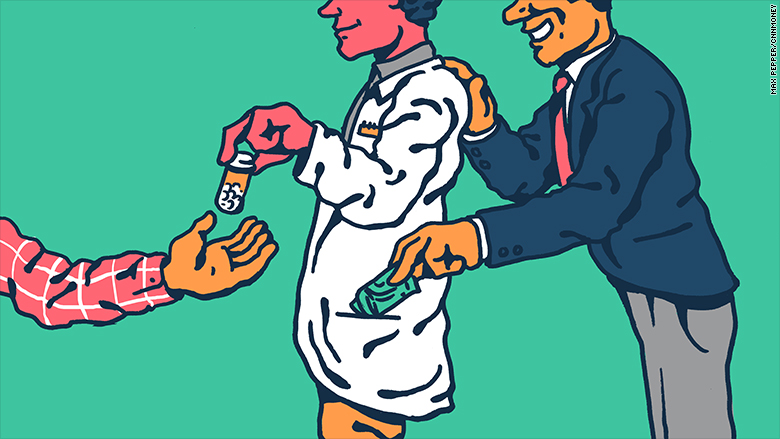
The recent announcement that a corporation agreed to pay $1.6 billion to settle regulatory violations would normally be considered significant news, but because the company involved was a drugmaker there was not much of a stir. That’s because Abbott Laboratories is only the latest in a series of pharmaceutical producers to pay nine- and ten-figure amounts to settle charges that they engaged in illegal marketing practices.
Abbott’s deal with federal and state prosecutors involves Depakote, which was approved by the Food and Drug Administration to treat seizures but which Abbott was charged with promoting for unauthorized uses such as schizophrenia and for controlling agitation in elderly dementia patients. The company admitted that for eight years it maintained a specialized sales force to market Depakote to nursing homes for the latter unauthorized use. In other words, it systematically violated FDA rules and encouraged doctors and nursing homes to use the drug in potentially unsafe ways.
Abbott follows in the footsteps of other industry violators:
- In November 2011 GlaxoSmithKline agreed to pay $3 billion to settle various federal investigations, including one involving the illegal marketing of its diabetes drug Avandia.
- In September 2010 Novartis agreed to pay $422 million to settle charges that it had illegally marketed its anti-seizure medication Trileptal and five other drugs.
- In April 2010 AstraZeneca agreed to pay $520 million to settle charges relating to the marketing of its schizophrenia drug Seroquel.
- In September 2009 Pfizer agreed to pay $2.3 billion to settle charges stemming from the illegal promotion of its anti-inflammatory drug Bextra prior to its being taken off the market entirely because of concerns that it was unsafe for any use.
- In January 2009 Eli Lilly agreed the pay $1.4 billion—then the largest individual corporate criminal fine in the history of the U.S. Justice Department—for illegal marketing of its anti-psychotic drug Zyprexa.
The wave of off-label marketing settlements began in 2004, when Pfizer agreed to pay $430 million to resolve criminal and civil charges brought against Warner-Lambert (which Pfizer had acquired four years earlier) for providing financial inducements and otherwise encouraging doctors to prescribe its epilepsy drug Neurontin for other unapproved uses.
Soon just about every drugmaker of significance ended up reaching one of these agreements with prosecutors and shelled out what appeared to be hefty penalties. In fact, the amounts were modest in comparison to the potential revenue the companies could rake in by selling the drugs for uses far beyond what the FDA review process had deemed safe. A 2009 investigation by David Evans of Bloomberg noted that the $2.3 billion penalty Pfizer paid in connection with Bextra was only 14 percent of the $16.8 billion in revenue it had enjoyed from that drug over the previous seven years.
The company’s 2004 settlement should have been a deterrent against further off-label marketing, but, according to Bloomberg, Pfizer went right on doing it. Seeking maximum sales, regardless of restrictions set by the FDA, was an ingrained part of the company’s modus operandi. When the 2009 settlement was announced, John Kopchinski, a former Pfizer sales rep turned whistleblower, was quoted as saying: “The whole culture of Pfizer is driven by sales, and if you didn’t sell drugs illegally, you were not seen as a team player.”
Compared to other forms of corporate misconduct, such as securities violations, the drug companies are much more likely to have to admit to criminal violations in the off-label marketing cases. And the penalties are far larger than those imposed for most environmental and labor violations.
Yet these seemingly harsher enforcement practices appear not to have been very effective in putting an end to the illegal activity. In fact, the willingness of the drug industry to flout the drug safety laws raises serious questions about the effectiveness of FDA regulations and the federal criminal justice system in general. If a group of companies know that they can repeatedly break the rules and face consequences that fall far short of the potential gains from the illegal behavior, enforcement has little meaning.
What makes the situation even more outrageous is that off-label market is just one of numerous ways that the drug industry regularly violates the law—whether by defrauding federal programs such as Medicare or by covering up safety risks related to the approved uses of certain drugs.
The one thing that makes drug industry executives a bit nervous is that federal prosecutors have begun to show interest in reviving what is known as the responsible corporate officer doctrine, a provision of U.S. food and drug laws that could be used to hold executives personally and criminally responsible for violations. So far, the doctrine has been applied to only a few small fish. But if Big Pharma CEOs start appearing in perp walks, the industry may finally realize it is not above the law.
Conservatives are feeling smug. The recently completed Supreme Court oral arguments on the healthcare law were replete with skepticism about the powers of the federal government and glorification of personal liberty, though what was being celebrated was the dubious right of a person to be uninsured against the risk of a catastrophic medical event.
The House of Representatives, in a rare embrace of de-privatization, has just
You’ve got to hand it to the health insurance corporations and their front groups for knowing how to play hardball. To protect the interests of the industry, they have been willing to spread outlandish allegations about euthanasia, gambling that the ensuing uproar will force nervous Dems to dilute their plan.
As the
Would a consulting company owned by Exxon be considered an impartial source of analysis on global warming, or would such a firm owned by Xe (formerly Blackwater) be regarded as a good judge of federal policy on the use of mercenaries? Probably not; in fact, they would, in all likelihood, be seen as front groups for the interests of their corporate parents.
Is Rick Scott following the T. Boone Pickens playbook? Pickens is the notorious corporate raider who moved into the public policy arena with his advocacy of wind energy. Scott (photo) is the former chief executive of
President Obama and the Democratic leadership say they are serious about enacting health care reform this year, but if the current behavior of some leading Senate Democrats is any indication, we are headed for the weakest kind of change. Some of these senators seem more concerned about protecting the private health insurance industry than in creating a system that does the most to help the uninsured and the underinsured.
Aside from the dubious continuation of bank-coddling bailout policies, perhaps the most dissonant domestic policy theme expressed by President Obama is “entitlement reform.” He just used the phrase again in a