 If Congressional Republicans succeed in enacting either the Senate or the House bill to repeal the Affordable Care Act, they will have carried out one of the most brazen bait and switch moves in the history of U.S. public policy.
They and Donald Trump campaigned on the idea that Obamacare exchange premiums were rising uncontrollably, yet neither of the bills does anything to address that problem. They did not vow to repeal and replace Medicaid — Trump, in fact, promised not to touch it or Medicare or Social Security — yet that is what the bills would in effect do, both for the ACA’s Medicaid expansion and traditional Medicaid.
It’s been widely noted that the Republicans seem preoccupied with repealing the taxes the ACA imposed on high earners to help pay for the cost of expanding coverage. Yet less attention is being paid to the other giveaway in the bills: the repeal of the ACA’s employer mandate. This provision should be called the Wal-Mart Windfall Act, because it would allow large low-road employers to avoid ACA rules that oblige firms with 50 or more full-time employees to provide health coverage or else pay a penalty.
The mandate is far from draconian, yet it was at least a partial remedy for the situation in which millions of workers at big-box retailers, fast-food outlets and similar workplaces were not provided affordable coverage and were encouraged to enroll in programs such as Medicaid. Now the Republicans seek to remove any obligation on the part of employers to provide coverage while also undermining the social safety net alternative.
To the extent that the Republicans have a solution to the healthcare problem it is this: bring back junk insurance. It is often forgotten that the ACA was designed not just to address the problem of the uninsured but also the underinsured.
Starting in the 1990s, large insurers such as Aetna began selling bare-bones individual policies to low-income individuals who did not get employer coverage and could not qualify for Medicaid. These policies had relatively low premiums but sky-high deductibles and numerous exclusions. In cases of a serious accident or illness, they were all but worthless. The ACA put an end to this predatory market by establishing a set of essential benefits that all plans would have to include.
Republicans don’t like to admit that they are promoting a return to crappy coverage, so they dress up their arguments with misleading phrases such as “patient-centered reforms.” Many of them also realized that the idea of lowering standards directly was not very popular, so they have returned to their favorite panacea of giving states more flexibility. This allows them to pretend they are not scrapping essential benefits while knowing that many governors and state legislatures would be all too willing to do so if given the opportunity.
The cynicism of Congressional Republicans is matched by that of the big insurance companies, for whom the ACA was tailored and are now doing nothing to defend the law. Instead, they still seem to be sulking about the two anti-competitive mergers (Aetna-Humana and Anthem-Cigna) that were opposed by Obama Administration and shot down in the courts. Having seen their oligopolistic dreams go up in smoke, they now seem to want to give up the ACA market in favor of selling bare-bones policies.
It is unclear whether the dystopian vision of the ACA opponents will come to pass, but in the meantime the wellbeing of millions of Americans is being unnecessarily endangered.
 Massey Energy is notorious for the 2010 Upper Big Branch disaster that killed 29 workers at a coal mine with a long history of safety violations. Yet Massey, now owned by Alpha Natural Resources, has another dubious distinction: it was responsible for the largest back pay award mandated by the National Labor Relations Board in recent years.
 For months the news has been filled with reports of suspicious meetings between Trump associates and Russian officials. Another category of meetings also deserves closer scrutiny: the encounters between Trump himself and top executives of scores of major corporations since Election Day. What do these companies want from the new administration?
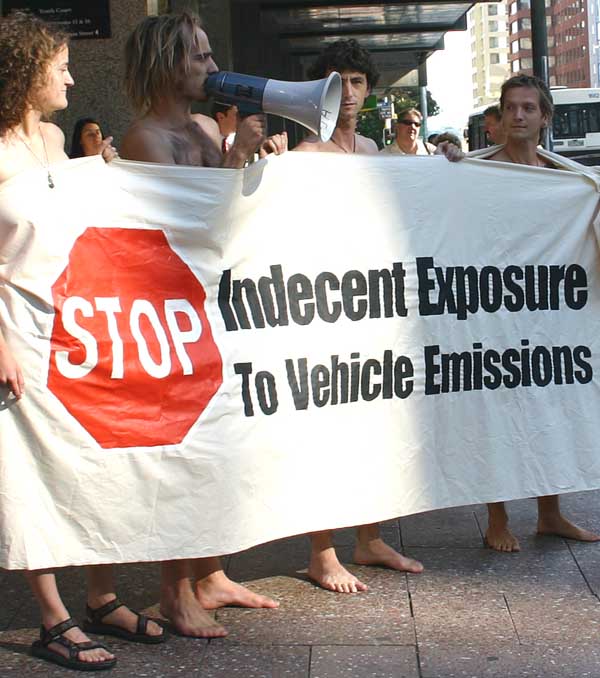 Big business would have us believe that it is on the side of the angels when it comes to the Paris climate agreement. A group of large companies just published full-page ads in the New York Times and Wall Street Journal urging (unsuccessfully, it turned out) President Trump to remain in the accord.
 It remains to be seen how high the new special counsel Robert Mueller aims his probe of the Trump campaign, but there are
  The Justice Department has a lot on its plate these days, but it has apparently found time to cook up a deal that would save Wal-Mart hundreds of millions of dollars. According to
  Lurking behind the assault on regulation being carried out by the Trump Administration and its Congressional allies is the assumption that corporations, freed from bureaucratic meddling, will tend to do the right thing. That assumption is belied by a mountain of evidence that companies, if allowed to pursue profit without restraint, will act in ways that harm workers, consumers and communities. In fact, they will do so even when those restraints are theoretically in effect.
 We now know who it was Donald Trump was really addressing in his convention speech last summer when he declared “I am your voice”: the Forbes 400 and others in the upper reaches of the 1 Percent.
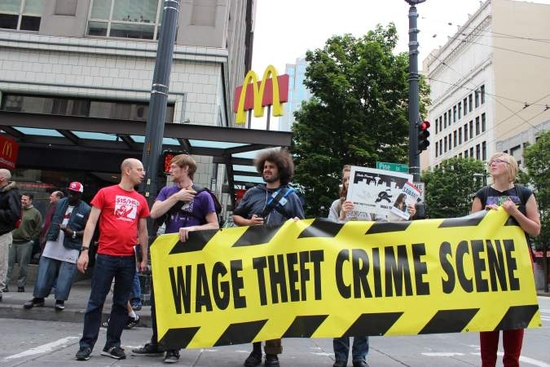 Several weeks ago, in one of his few legislative successes, President Trump signed a bill rescinding the Obama Administration’s executive order on Fair Pay and Safe Workplaces. The order, designed to promote better employment practices by companies doing business with the federal government, instructed procurement officials to consider the labor track record of contractors, which were required to disclose their recent violations.
 Given his own string of business controversies, it perhaps should come as no surprise that Donald Trump does not seem to worry much about the accountability track record of the companies from which he has recruited key members of his administration.