 It’s common for governors to stage publicity events to announce major job-creating investments in their state. This allows them to take implicit credit for a project that was probably helped along with tax breaks and other financial giveaways.
When it came to the Taiwanese company Foxconn’s plan to build a $10 billion flat-screen plant in Wisconsin, the hype was taken to a new level. Gov. Scott Walker and Foxconn’s Chairman Terry Gou made the announcement not at the state capitol but at the White House, where they were joined by President Trump, Vice President Pence, Speaker Paul Ryan and a host of other high-level officials of the federal government.
As you might expect, the event quickly turned into a celebration of the Trump Administration. Walker, Pence and Ryan, in whose Congressional district the massive plant is to be sited, gushed about Trump’s economic leadership, with Pence declaring: “Under President Donald Trump, America is back.”
That apparently was not enough for Trump, who found it necessary to celebrate himself even more. Referring to Gou, the President declared: “If I didn’t get elected, he definitely would not be spending $10 billion” in the United States.
The creation of numerous new manufacturing jobs is something that will be welcomed by the working people of Wisconsin, but there are reasons, beyond Trump’s political exploitation of the deal, to remain suspicious.
The first matter of concern is the company itself. Foxconn has a long history of abusive labor practices in its overseas plants, including those used to supply Apple. Conditions in the company’s Chinese plants were so bad that in 2010 there was a rash of suicides among overworked employees. The company installed nets on its plants to discourage workers from jumping to their deaths. Foxconn later claimed to improve its labor conditions but the company is far from a high-road employer.
Then there are the claims about the terms of the Wisconsin deal. Gov. Walker claimed that the plant would directly create 13,000 jobs. That was good for generating excitement, but it is a dubious figure. Manufacturing establishments no longer employ anything close to that number of workers.
Out of curiosity, I checked with the Bureau of Labor Statistics to see how many plants currently exist with 10,000 or more workers. It turns out the BLS does not have that information because, as an analyst told me, there are so few facilities of that size. The trend, of course, is toward higher levels of automation and much smaller workforces.
Then there’s the issue of who is paying for the plant. While Trump and the others praised the deal as an example of private sector vitality, Foxconn’s plant will be underwritten in large part by the taxpayers of Wisconsin. Walker said that the state would “invest” $3 billion in the project. That would be the fourth largest economic development subsidy package ever offered by a state.
Despite the promises of public officials, extravagant subsidies rarely provide economic benefits equal to the loss of tax revenue. Wisconsin has a particularly bad record in this regard. The Walker Administration and its privatized economic development agency have been at the center of a long string of controversies about cronyism and poor job-creation outcomes.
The Foxconn deal will provide political benefits for Walker, Ryan and Trump, but it is unclear how much good it will actually do for the people of Wisconsin.
 For months the news has been filled with reports of suspicious meetings between Trump associates and Russian officials. Another category of meetings also deserves closer scrutiny: the encounters between Trump himself and top executives of scores of major corporations since Election Day. What do these companies want from the new administration?
 The Justice Department has a lot on its plate these days, but it has apparently found time to cook up a deal that would save Wal-Mart hundreds of millions of dollars. According to
  Lurking behind the assault on regulation being carried out by the Trump Administration and its Congressional allies is the assumption that corporations, freed from bureaucratic meddling, will tend to do the right thing. That assumption is belied by a mountain of evidence that companies, if allowed to pursue profit without restraint, will act in ways that harm workers, consumers and communities. In fact, they will do so even when those restraints are theoretically in effect.
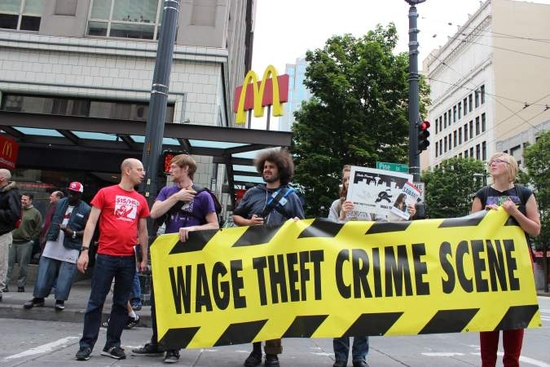 Several weeks ago, in one of his few legislative successes, President Trump signed a bill rescinding the Obama Administration’s executive order on Fair Pay and Safe Workplaces. The order, designed to promote better employment practices by companies doing business with the federal government, instructed procurement officials to consider the labor track record of contractors, which were required to disclose their recent violations.
 Given his own string of business controversies, it perhaps should come as no surprise that Donald Trump does not seem to worry much about the accountability track record of the companies from which he has recruited key members of his administration.
 The ACA repeal-and-replace effort, given up for dead two weeks ago, may or may not be getting resurrected. Whether that happens seems to depend on satisfying the desire of Tea Party Republicans to grant Americans the right to purchase the crappiest health coverage possible.
 The signing ceremony for Donald Trump’s executive order nullifying the climate initiatives of the Obama Administration was staged so that about two dozen miners looked on adoringly as the president claimed to be ending the so-called war on coal. Trump then repeated his promise that the regulatory rollbacks would “put our miners back to work.”
 Once upon a time, a key component of American populism was the demand for stricter controls over big business: in other words, regulation. Today, the country’s purported populist in chief is instead promoting the dubious claim that deregulation is what will benefit the masses. Through executive orders and now with his administration’s
You must be logged in to post a comment.